My latest book is The One Who Swam With The Fishes.

"A mesmerizing account of the well-known story of Matsyagandha ... and her transformation from fisherman’s daughter to Satyavati, Santanu’s royal consort and the Mother/Progenitor of the Kuru clan." - Hindustan Times

"Themes of fate, morality and power overlay a subtle and essential feminism to make this lyrical book a must-read. If this is Madhavan’s first book in the Girls from the Mahabharata series, there is much to look forward to in the months to come." - Open Magazine

"A gleeful dollop of Blytonian magic ... Reddy Madhavan is also able to tackle some fairly sensitive subjects such as identity, the love of and karmic ties with parents, adoption, the first sexual encounter, loneliness, and my favourite, feminist rage." - Scroll


Sign up for my newsletter: The Internet Personified

Showing posts with label Column. Show all posts

4 October 2019

Crosswords are totally romantic

26 across: moves aimlessly

I punch in “drifts”, which fits with “igloo” my answer for 28 down: traditional Arctic abode.

Crosswords have always seemed like a couple activity to me. Blame it on an old sweetheart who waited for me near the gates of my college with the Delhi Times crossword conveniently folded to the right section and a cigarette for me behind his ear. (He couldn't wait for me at the gate because the college was for “women only” and was guarded by a fierce man with a stick who took his job as Protector very seriously.) Some days, it would be just the right kind of winter sunshine, warm and mellow on our faces. Some days, it would be aridly, desperately hot, and I'd have to stop on the way out in a nearby loo to spritz some floral body spray fragrance all over me, in the kind of bottle that was trendy then: small, and blue or pink, with a sickly-sweet bubblegum-meets-jasmine undertone. Sometimes, he would have already done a few of the clues, but he saved most for us to solve together, our heads bent over the page. Since I've always been one for tall men, and I haven't grown since I was sixteen, you have to imagine us, him bending down like a dandelion in the breeze, me lifting myself up on my toes like a pansy straining at the roots.

My current relationship started off in a weird way, with a crossword too. I was bored and on Twitter (which happens a lot) and decided to solve the Guardian quick crossword with my followers. So I was tweeting out a clue every 25 seconds, entering in people's guesses, and generally having a grand old time. Into all this, I got an email from an old acquaintance who had been following me on Twitter, remembered I lived in Delhi and asked if I wanted to meet for a drink some time. Many years later, old acquaintance and I do not sadly, do the crossword together, as I had envisaged, but we do read together on Sunday mornings, sometimes. And raise a family of three cats and several house plants we're trying not to kill.

The crossword always seems like it should be a somewhat solitary activity, and yet, I'm always coming across evidence that it is the next big romantic tool. My friend Umang* (names changed everywhere) introduced me to an app called Shortyz when her and I were on holiday together. Shortyz downloads free crosswords from all over the place, and when you're doing a road trip holiday that involves a lot of sitting and waiting, like we were, it was the perfect thing to keep us occupied. “How did you find this app?” I asked, delighted. “Oh, my boyfriend, and I solve crosswords together all the time!”

Funnily, the word itself, broken down, sounds like it should indicate a fight. Cross words were spoken between the two as they couldn't agree on a clue. And yet, I think it works as a metaphor for modern relationships. Will your 43 down meet his 51 across for a perfect match? Will your words marry each other with an almost audible click as you realise you're perfect for each other? Neither mine or Umang's Crossword Relationship lasted forever, but we had gotten out of it a tendency to watch how we laid out our words—side by side or up and down—so that in the end, everything is spelled out and there are no blank spaces left.

20 January 2018

Tsundoku: three books to begin 2018 with

This appeared as my column in BLInk in January

Happy new year, readers! I have just—for the third year running—set my reading challenge on a website called Goodreads. It lets you log and rate each book you read, and by the end of the year, you have a nice record of all your reading habits. It's been quite invaluable for me, since I read a lot, and often forget what I was reading a month or two ago. Another new habit I've started is a reading journal, a sort of companion to my Goodreads challenge, where I write down the books I'm reading, my thoughts and add lists of books I'd like to read in the coming month. With those resolutions in mind, this month's theme is new beginnings, and what better way to start than to inspire yourself with some books?


Water cooler: Even if you're not on the publishing circuit, it's very likely you would have heard about Sujatha Gidla's book Ants Among Elephants: An Untouchable Family and the Making of Modern India. It's been widely reviewed in the US, where it was first published, and even though it just came out in India a few months ago, the buzz has been building around it. Through meticulous research and lots of interviews, Gidla has managed to put together a fine portrait of a young untouchable man—her uncle—who grew up Christian but renounced religion when he joined India's nascent Communist party. There are stark pictures of poverty and injustice in this book, and I warn you, it is not an easy read, but it is a necessary one. Gidla moves down the generations, from her grandfather, who was a teacher, to this uncle who changed his fortune, and also manages a look at the life of her own mother, an intelligent sharp woman, who also became a teacher, despite an unhappy marriage and three small children. Make this the year you find out more about the varied histories of India, not just the stuff in your old school textbooks, and this book with its focus on the rise of the student movement and how it affected young lower caste men will give you the alternate view you never knew you were missing. Ants Among Elephants by Sujatha Gidla, Harper Collins, Rs 599.

Watchlist: I don't know about you, but this is the year I tried to get away from all the bad news by reading a lot more about people who survived in the wildnerness, alone. Something about being all by myself was greatly appealing to me this year: even if it was just reading about it. Perhaps your resolution is to exercise more, and what better way to inspire yourself than by reading Cheryl Strayed's gorgeous memoir Wild? The book is the story of how she trekked the Pacific Trail, a long hike that cuts across a large part of America, and has been written about often, most famously by Bill Bryson in A Walk In The Woods. Wild has also been made into a movie, starring Reese Witherspoon, but even if you've watched it, I urge you to read the book as well, because not only is it a walking memoir, it's also a grief memoir, as Strayed, who has just lost her mother and her marriage, resorts to walking eleven hundred miles just to make sense of it all. Her prose is almost like poetry, and even though her pack is heavy and her shoes are tight, it'll make you want to follow in her footsteps. Wild by Cheryl Strayed, Penguin Random House, Rs 399.

Way back: And perhaps, you're inspired by my own resolutions at the top of this column, and want to build up your reading habit. The first question is always, “Okay, but what shall I read?” For this, and for a love letter to books and reading, pick up Anne Fadiman's Ex Libris, a book I first read at age nineteen, but which I can still remember vividly, like an old, dear friend. In this slim volume of essays, Fadiman moves from subject to subject deftly and often, humourously. There's one about what happens when you mix your books with your husband's, what do you do with the spare copies? Another on the treatment of books: do you dog-ear to mark the page, or are you fastidious about bookmarks and never placing your book splayed across a pillow? And my particular favourite: the essay about books about food. Delicious. Fadiman says in her preface that she began writing the book when she noticed how books were being sold like toasters—one cheaper than the other, which one was a better one and so on. She wanted, instead to address the people for whom reading also lay in having a connection with your old books, not just which new book to buy. I think that still holds true. Ex Libris by Anne Fadiman, Rs 443, Penguin Random House

11 January 2018

A Happy (Feminist) Marriage to You

(This appeared as a version of my Aunty Feminist column in Youth Ki Awaaz in October 2016) 


T asks: I am 27, and am planning to have an arranged marriage. Tinder, OKC, Aisle etc, failed to find a match for me so I have never been in a relationship. Could you point out the sexist things men do in a relationship and how to resolve it? Also, what can I do to empower my future spouse?


Dear T,
These are both excellent questions, and I congratulate you on wanting to be more informed before you make these hugely important decisions. So many people don't. It's basically the equivalent of reading the user manual before you begin.


I think this is a good first step to answer the second part of your question. What can I do to empower my future spouse—you do what you've just done. You ask. You make it known that you are going through life as her partner and companion, not her boss or her jailer. If she's feeling like she hasn't got what she needs from you, in terms of support, you need to foster an environment in your home where she's okay asking. And you're okay asking too! This is not a one-way street: marriage is about two people (and only two people, not four or five or twenty, like Indian extended families seem to believe!) having each other's backs. Those are the best relationships I've seen.

You also need to live by that millennial phrase (which the New York Times called “narcissistic” but still good advice) “you do you.” Let your wife be herself. Allow for a relationship with no judgements, and safe spaces to talk about yourselves. It is possible to have a relationship with no judgements at all, and that will happen once you are both secure enough to speak your minds freely.


As for the first part of your question, it got me thinking. Women object to sexist remarks primarily when they can be avoided. Like, for example, I'm having a fight with a male colleague and I tell him his work is not up to standard and he really let me down by missing this deadline. And instead of responding with either a justification or a critique of my work (“well, your deadlines haven't been that great either!”) he says, “Why are you being so emotional?” That derails the whole conversation because it brings it from a conversation about work to a conversation about how I'm feeling and how I'm reacting, which is really not the point in question here. That automatically puts the woman on the back foot. Similarly in a relationship, when you're having a fight with your male partner and he puts your entire fight down to the fact that you might be on your period. A) Women can get mad without hormones being involved. B) Someone being on their period is not a Get Out Of Jail Free card for the other person. 


When you are with someone—whether man or woman—you need to think of them as a whole person and not just a supporting character in a play you're the star of. This may seem pretty obvious, but you'd be surprised how easy it is to forget. That person you're bringing down has a whole play going on that's just about her, and so on and so forth. So when you say something guaranteed to slice at her sense of self, her ego, little paper cuts guaranteed to bring her down, take a moment to remember that you, a supporting character in her play, have just turned her plot into one about how a man was determined to believe that all her flaws were because she was female.


Another thing to bear in mind before you embark upon marriage is the very essential and often overlooked conversation about gender roles. Who does what? What do you expect and what does she? Honestly, if you're both arguing about cooking, either take turns or hire someone to help out. Or put aside a large chunk of your monthly budget on home delivery. If you think the laundry should be done once a week and the beds made every day, do these things yourself or offer to take turns. Similarly with the stuff that's important to her. This may seem like a small step, but it's leading up to bigger ones: dividing child care and elder care fairly and responsibly.


But you know what, dear T? I think even though you've never been in a relationship before, that you'll do great. Because you're not afraid to ask difficult questions, and I hope, you're not afraid to hear the answers as well. And that's really most of what it takes.


Love,


Aunty Feminist

9 January 2018

This Curated Life

(This appeared as an F Word column last year. Happy to report I no longer check my phone first thing in the morning)


My first thing in the morning practise is a bad habit I'm trying to get over. I open my eyes, I roll over, reach out blearily for my phone and flick-flick-flick, within moments of being jolted out of dream world, I'm out in the public eye, in the middle of a crowd, learning what everyone is up to. Usually, nothing exciting has happened, nine times out of ten, nothing exciting has happened, but the tenth time, that's the time we live for, the time when one of your posts blows up, when one of your photos gets so many likes, you wonder what's happened, when one of your tweets has been shared across the globe. Can you imagine going for a party as soon as you wake up? No coffee, no brushing your teeth, your hair fanning Medusa-like around your face?

When did we start living our life just so we could curate it?

I recently read an article that talked about how, out of all the social media apps out there, Instagram was the most likely to cause depression. Apparently, the young people polled for the study said that the photo-sharing app caused feelings of low self-esteem and negative body issues. I'm probably too old for that study—being able to remember a time before the internet officially puts you out of the running for “young people polled” but I do know on days like today when it seems everyone is on their holiday and have beautiful bodies, that I feel—not depressed—but like my life is somehow lacking.

Just a quick flick through of my Instagram feed at the moment reveals the sort of life that we would all like to live. Since it's World Yoga Day, there are women in sports bras and tights bending over to do poses, their stomachs flat and unwrinkled. Beautifully plated food appears, mine never comes close to this sort of powdered sugar perfection. All my food photos in fact seem to break down the dish in front of me to the ugliest colours—brown and yellow, with no hints of what makes it tasty. Even the books posts are aspirational—against very white bedsheets, next to stem vases with a single rosebud.

I'm guilty of the same crimes. Why take the full scene in front of you when you can focus on the small and delicate? Why post the first picture you take of yourself when you can take several, and pick the best one? My phone even comes with a “beauty mode” for selfies: it makes my eyes bigger, and my skin flawless. I forget that isn't me, and when I look in a mirror after, I'm often taken aback, aghast: is that what I look like?

But then I'm in the habit of it, and then also, there's a small part of my brain which is judgemental and petty. This is the part that laughs at ugly babies, that feels a sense of schadenfreude when something unfortunate happens to someone else. It is the id, the part of my brain that determines sexuality and “I want” cravings, it demands instant gratification, it gets to choose what dreams I have. As an adult, my ego and super ego are supposed to be stronger than my id, I am, after all, a rational, empathic human being, but I'm afraid, so afraid, that all this Facebook-Twitter-Instagram stuff is making my id stronger and stronger, and soon the other parts of me will be subsumed entirely, leaving no place for rational thought just “I want” and more “I want it now.”

I think we are doing each other a disservice when we post beautiful pictures. I mean, I get it, I really do, taking a good photo is part of the art of photography, I feel the same sense of achievement as when I write a good sentence, but the selfies, the clothes, the curated life, it's harmful. I'll illustrate: take two friends: Shobha and Neha. Shobha is stylish, travels a lot for work and loves putting up photographs featuring herself in Greece, a glass of wine in her hand, the sunset behind her. Neha wants that life, who wouldn't, but is stuck in a job that ties her to the city and is seldom very social. Neha used to be happy with her life, but now all she sees is Shobha's world, Shobha's manicured fingers, Shobha looking thrilled as she globe-trots, and Neha is stuck with a feeling of dissatisfaction that soon turns to despair. What is the point of her life if it isn't like Shobha's? Neha is no longer happy or content where she is. You could argue that this is an age-old problem, that even before the internet there were Shobhas and Nehas, but then they would have seldom met, not having that much in common. With the internet, everyone is our best friend, and everyone seems to have a better life.

In the end, it seems the only solution is one many people I know are turning to. Deleting the apps, putting down their phones and going back to their ordinary-extraordinary lives.


28 December 2017

Tsundoku: Two memoirs and one narrative non-fiction book I loved

(A version of this appeared as my column for BLInk in July)

I realised after I made the list for the books I was going to include in this edition that all of them were either autobiography or narrative non-fiction. This is a pleasant departure for me, since my leisure reading is almost always fiction, but I had made a resolution last year to add more non-fiction to my list. Do memoirs count as non-fiction? They're mostly stories—and the gold standard for non-fiction is those heavy-with-research tomes which are still light and readable. I buy them with every good intention and a few months later, they're paperweights or are propping up my projector. Oh well. These three books should help ease you into that set if you're a fellow fictionhead too.

Water cooler: We're all thinking it: how does an author like Ruskin Bond, who writes about unstylish things like walking in the hills and rooms on roofs, stay so enduringly popular? He doesn't even do the lit fest circuits, even though from all accounts, he's unfailing pleasant and generous with his time if you meet him in person. And yet, this year saw not one, not two but three memoir-y books by Bond: a reading memoir, recollections of his father, and the one everyone's talking about, Lone Fox Dancing, his straight up autobiography. I've been a Bond fan since I was little and he was twice a “required reading” book on my school syllabus, but having long outgrown the markets and vistas he talks about, it was almost like a reunion for me, it had been so long since we had last met. Lone Fox Dancing is marked by Bond's quiet style, the people are real and well-described, the story meanders from plot point to plot point like a gentle river, and all of it so vivid and so real, it's like it happened yesterday. Through it also the reader gets a sense of Bond's intense loneliness: the child abandoned, practically, by his mother who creates a new family for herself, the beloved father who dies young, the young student in search of love and finally, the adult who retreats into isolation by choice. Lone Fox Dancing by Ruskin Bond, Speaking Tiger Publishing, Rs 599.

Watchlist: The biggest news to hit my social media feed recently was the case of Zohra Bibi, a domestic worker employed in a building society in Noida, who didn't go home one night because she had been locked into a room by her employers. Her friends and neighbours rose up en masse, FIRs were filed, and think pieces abounded. About the perfect time to read Tripti Lahiri's new book: Maid In India: Stories Of Inequality and Opportunity Inside Our Homes. Lahiri speaks to the bosses as well as the maids, cutting a neat cross-section across the country: from the villages the women have left to make new homes in the cities, to the quiet, birdsong-filled mansions of Lutyen's Delhi. I wish she had spoken to more of the male help that exists, the drivers, the “man Fridays” and so on, but I suppose that would have been a different sort of book. As with all texts and stories about “the help” in India, you'll probably be left feeling guilty and defensive or smug and “I do what I can” but it's also worth examining your own responses to the book to figure out how the great inequality that exists in India works on you. Maid In India: Stories of Inequality And Opportunity Inside Our Homes by Tripti Lahiri, Aleph Book Company, Rs 599.


Wayback: Since I made this list thinking of memoirs, I'm recommending one of my all-time favourite autobiographies as the nostalgia pick for this week. I got put on to Agatha Christie's An Autobiography from a Facebook post made by a friend, instantly got it for my Kindle and spent the next week (it's gloriously fat) wrapped up in Christieland. Even non-mystery lovers will find things to love about her recollections of a Victorian childhood, growing up during the war, her house and her pets and her sister, the minutiae of life that is so engaging when you're reading about someone else's. The mysterious years after her husband left her where she just vanished are never alluded to, I'm afraid, but there's plenty about how she worked during the war in the pharmacy of a hospital and thereby got acquainted with all the poisons she puts into her mysteries. Also, about how much she hated Hercule Poirot. An Autobiography by Agatha Christie, Harper Collins, Rs 250.


26 December 2017

Ugh, why can't I just buy face cream already without being hit with a patriarchal burden?

(This appeared in  February 2016)

Today I tried to buy a face cream. (Yes, I know, I know, they're mostly a rip-off, and there's no science that says regular body lotion can't be used on your face, but I'm a woman and susceptible to these things.) I say “tried” because no matter how many search results I saw online—and I waded through loads—all of them offered me “whiteness improving night cream” or “fair and bright day cream.” Nothing was just plain old face cream, as far as I could tell, until I landed on one simple one, not at all as nicely packaged as the others, but a face cream that was just that: cream for your face, without any added transformative effects.

The page refreshes to show items that are “based on your order” after you buy something. Here's what I got for the cream I had so painstakingly purchased because it didn't offer me a two-for-one fairness deal: Whitening Day Cream and Whitening Face Wash. The website seemed to be taunting me: oh, you didn't get the fairness cream? Why not add it now? It reminded me eerily of going to a beauty parlour and having my eyebrows done when I was younger with the beautician asking if I didn't want a “detanning facial” or a scrub. When I'd say no, I was quite happy with my tan, she'd make a face and say, “Well, your eyebrows are very weird.” (I stopped threading my eyebrows into oblivion after it was made quite clear that no one actually noticed my eyebrows even though that whole operation is extremely painful.)

White facing like a boss


I suppose I shouldn't be so surprised that fairness has become the default for beauty. From people having a choice to aspire to be fair, bringing about brands such as Fair And Lovely (and its male counterpart, Fair And Handsome), it's become something companies think you want so much that they don't seem to make any other options.

My first reaction was to blame the companies. I mean, if Olay or Garnier or Lakme weren't pretending these were the only ways women could keep their skin beautiful then we wouldn't buy into it. But then it's probably also the customer's fault. Sadly we've been conditioned to think that our skin needs to be pink and white to be beautiful—something that's almost impossible for most of the country. If you think of India itself by its skin colour, it varies so much that yes, some of us are fair—but there's milky fair which becomes bluish or yellowish fair, moving into a reddish tinge and then there are all the browns: from golden skin to light brown to dark brown to very very dark brown. We have them all—and the funny thing is that no beauty company has found a way to market to that. I, with my coffee-coloured skin, would enjoy a cream made for my complexion, as would someone who was perfectly fine with the amount of “white” they were and just wanted to stay that way and not get any paler.

The most ironic thing is that they don't actually work. Nothing can make you fairer if you have melanin in your skin. It's something that you know and I know, but people all over the country are buying into this myth, and therefore buying into the companies. Week after week they slather these snake oils on their skin and when they don't as the ads say “grow many shades lighter” they're deeply disappointed. The consumer court made Emami Limited, a skin care product company known for their brand Fair And Handsome, pay a 15 lakh fine for misrepresenting costumers. The complainant was a man called Nikhil Jain from Mumbai who said he didn't see any difference in his face after 3 weeks, even though he had been using the cream.

[I find it interesting that a man brought in this case, because I'm sure there are thousands, if not millions of women in India who have thought the same thing and haven't had the courage to admit they wanted to be more beautiful. Interesting also that according to a sales trend report done by Snapdeal recently, more men than women are buying fairness creams and grooming products.)

I would like options. We'd all like options. And I'd like people to be more careful about what they promise in advertising. Is this an utopian ideal? Perhaps. But if enough of us want it—like enough of us want fairness creams—maybe it'll happen.


24 December 2017

An open letter to the man who thought he was being supportive but really wound up sounding patronising

(This appeared as my F Word column in March 2016)


Dear Man At A Recent Event I Was Speaking At Who Stood Up To Say, “I think mothers are the epitome of power and we should respect mothers,”

And when I said, “And what about those of us who aren't mothers?” you said, “Obviously I'm talking about the rule not the exception.” and then I rolled my eyes but it was quite clear that everyone wanted me to not Go Into It, because I'd been Going Into It all afternoon and the audience just wanted their cake and tea.

So I shut up.

But I thought of you later. You're obviously someone's son, and you're probably a dad as well. But when did your conception of women become narrowed and defined to just Woman As Mother?

Let me explain to you why your words made something cringe inside me, like you were scratching nails down a chalkboard. It was as if you were saying, “Women exist to give life, and it is that we should respect, and none of the rest of it.” It's as if you were standing in for society who has been looking askance at me as soon as I hit 25, wondering when I was going to stop faffing around and do what nature created me to do. It's also like you were saying women who are mothers don't count for anything else, their greatest role in life is basically producing their children. Who, if they are girls, will have their own greatest role to play and so on and so forth, until we're all Russian nesting dolls, our charm lying in the fact that our tops can be snapped off to reveal the generations that lie within us. 


I have not one hundred per cent decided that kids are not for me. I thought I had ruled firmly anti-child when I first hit my thirties, but now coming up on five years in this decade, I'm wondering if this is an option I should reconsider. Unfortunately, my decision rests not on any altruistic reasons to have children—Looking to the Future and Love of Small Creatures but on very selfish things: a) I'd like everyone to get off my back and b) I don't want to die alone. These, I'm sure you'll agree, makes me the opposite of Woman As Strong Mother and basically makes me one of those people who is so scared by her own mortality that she's thinking of ways to prolong that.

Like you, I too have my own personal mom. She's great, totally awesome, totally strong, kick-ass in many ways, and has done many things to shape me into the person I am today. But while my mother may have grown into her own personal stree shakti as it were during the time she was my mother, I like to think that she would have grown and evolved and become this person without me in her life as well. To put it more succinctly, even though she may say this out of love, I do not think her biggest achievement in life was to bring me into this world.

In fact, while I'm thinking of my mother, I'm also thinking of an old friend of hers who never had children, and who was around my whole childhood. She was the person who gave me Little Women when I was seven and told me that while the small print might be intimidating, I would love it (I did, and when I visited Louisa May Alcott's home when I was eleven, I was the only person shown into the writer's private writing room, an honour accorded to me as the youngest reader on that tour.) She treated me as a small adult, I can't remember a time she ever talked down to me, and that shaped the way I thought of myself—your parents don't count, because your parents are duty bound to love you and listen to you—as well as the way I speak to children now.

In many ways, I think of the older women I met, my mother's friends who didn't have children and yet who knew how to connect with a child. Would you call their lives pointless? Some were in my life only very briefly, but I remember them all so strongly. One friend I remember gave me a set of two carved combs shaped like a man and a woman. “Oh, a man and his wife!” I said, delighted and she looked at me and said, “Why not a woman and husband?” Why not indeed? That's the first time I ever thought about that, and it may have been a throwaway conversation, but somewhere in my head it took root.

What about the mothers who lose their children? What about women who can't have children? What about more like me who don't want to? What about the women who produce terrorists and murderers? A blanket statement like yours is so harmful because it brushes everything else under the carpet, because it airily dismisses everyone else as “the exception.” Why, I bet even the woman you're holding up as this ideal of Motherhood has mixed feelings sometimes about her own kids.

All this to say: sometimes you need to think before you speak. #notallmothers

With love,

A Not Mother But A Woman Nonetheless

20 December 2017

Sofa, So Good

(Wrote this in  April 2016. I've grown to like our sofa since.)

It has been nearly a month since we shifted into our new home and still, I haven't been able to have a party of more than four or five people over at a time. The reason? We have no sofa.


The eventual sofa plan


This may sound petty to you—certainly it's reading a little petty to me as I'm writing it—but being now of the age where folding oneself onto the floor for longer than an hour or two leads to creaky hips and aching backs (blame our sedentary lifestyles), I cannot, in all good conscience force my guests to discomfort. Once, we had about ten people over, and like a good hostess, I stayed standing while everyone got dining chairs, and by the end of the night, my knees ached with the effort of holding me up for so long. And I do yoga regularly.

After many weeks scouring online websites and finding nothing exactly perfect—eg: great shape, but too-delicate fabric, which wouldn't last a week around our cats; nice colour, but a bit boxy looking; prohibitively expensive for all its style—we decided to go the Indian way and have the sofa commissioned and made from scratch. A craftsman came recommended from a friend, we bought the yards of plain black (apparently cat-proof) fabric, handed it over to him with an advance and picked a design from his coffee table book catalogue. It was a deceptively simple looking sofa, sleek and stylish with rounded arms and comfortable enough for two people to lie, feet facing each other at the end of a long day. We imagined narratives around it, eventually we will acquire a projector and this will be the sofa on which we watch movies. I imagined my stylish friends, in pretty shift dresses standing out against the black fabric. I imagined the winter to come, how the sun would hit it in just the right spot, me and a cat curled up for an afternoon nap.

There are things in our new home I've never owned before: a dining table that seats six, and now a three-seater sofa, all indicating our couple-d lives, a “we” instead of an “I.” I put furniture into terms I can understand—like a set for a stage or a blank page of a Word document. What scene are we setting? This is a house that will be full of people we love. This is a house that will see us entertaining effortlessly. This is a house where there is a comfortable nook in each room for two readers to be alone together.

Unfortunately, the sofa maker didn't see it that way. Proud as we were of supporting local businesses and not going online (plus saving some money), it seems to be an uphill task. His first photos (sent weeks after the commission, despite my urging) were of a boxy black sofa. Comfortable? Maybe. But not our original design. We edited, I wailed down the phone, he sent back draft two: still not what we were waiting for.

Finally, we sent him a drawing marking out exactly what needed fixing. He claimed to understand, but also told me categorically that he wasn't a photographer. “Just come and sit on it, madam,” he said on the phone, “You'll see how comfortable it is.” Unfortunately, my Hindi does not extend to the point where I can convey that comfort is all very well, but it's not the original sofa that we chose from his catalogue, one he promised us he could make with no problems at all.

And that's why small businesses in India seldom do very well to an outside audience. For me, it's par for the course, having grown up in this country, I'm used to not having exactly what I want when I have something made, but for my European partner, it's sacrilege to pay someone for a service he considers unrendered. And probably, if this sofa ever gets made, and we use it and then in five or ten years time, we consider replacing it, it'll be the online route for us, just because this was such a time-consuming project, all the calls and all the photos and all the driving we have to do to his far away workshop, just to explain to a professional that the sofa he made for us was not the sofa he promised. (It's not like his labour was cheap either.)

And therein lies the problem: he sees it as “good enough,” we see it as “not what we wanted.” Will there always be this culture clash? And will online and factory shopping eventually give the customers what they want, so all these enterprising men will someday be history?


19 December 2017

Booze, Bihar and the middle of the country

(Written in  April 2016 just after the Bihar liquor ban)

Our yoga teacher, who hails from Bihar, always has an item of the news he'd like to discuss with us during class. Often, he gets so carried away, that he winds up talking animatedly about it, and I have to provide rejoinders from huffing and puffing on the floor. This is how I heard about the whole JNU anti-nationalist incident, how I realised what odd-even meant to most folks, and most recently, how I heard about the effect of the liquor ban was having in Bihar.

It's quite nice for someone like me, who doesn't really keep up that much with the news, to have this Talking Head, so to speak, in my living room thrice a week. His political views are almost diametrically opposed to ours, so there's often a lively debate during the stretches, while we all argue about whose way is the best.

My house help is also from Bihar, and when the yoga teacher said the liquor ban was making everyone in Bihar “dizzy,” she came out of the kitchen, clutching a dustcloth, looking anxious. “What's happened in Bihar?” she asked, and he said, “Why, they've banned alcohol,” and she looked relieved and left, but not before he had engaged her in a Whose District Is Best conversation. (I'm tempted to side with her, only because she's from Madhubani, and I've always been partial to their art.)

Not a problem anymore in Bihar!


Despite my father being posted in that state for much of my childhood and adolescence, I don't know very much about it. I have stray, scattering memories: once of a playhouse with a thatched roof, once of his collector's bungalow in Gaya which had two tortoises in the pond outside who I called Napoleon and Josephine. Of Gaya, my memories are strong—I remember being taken to see the famous Boddhisatva tree and that large garden, and a kitten we acquired for the winter holidays which died tragically of pneumonia. I had been allowed to ask a friend to stay for the holidays, and the two of us ran in and out all day, reading and bathing in the British era bathroom complete with porcelain tub, and ending the whole vacation with a play we put on for my parents.

But then, even though my father stayed on, he preferred to come to Delhi, where my mother worked and I studied, and as I grew older, the idea of a summer with nothing to occupy me except my own fantasies grew less charming. He had been back in Delhi for two years—very important two years, because this is when cable TV and the internet first came to India—and when he was posted back there again, those two things were greater than anything Patna could offer.

Anyway, so I didn't really think about Bihar beyond the occasional reminder that it existed. My father loved his time there, but I only remember it from some long ago summers, when I was too young to consider it as a whole. But the two people who I see the most often are from that state—so obviously Bihar is tied up more with my life than I think. What do I know about it now? Not a whole lot more. Thanks to these two people—I have a bit of representation—how that state votes for instance or how long it takes to travel to your far-off district from the state capital, which gives me an idea of the geography of it.

I think it may be time for me to pay Bihar another visit—this time as someone who was reluctantly linked to it her whole life—even though I may not get a good glass of wine (let alone any kind of glass of wine). If our fates are entwined—Bihar's and mine, then it's time to get to know her a little bit.

18 December 2017

Smoking and the "cool girl" myth

(This appeared as my F Word column in December 2015.)

I haven't always been a smoker, of course. There was a time when my young lungs were disgusted by the idea of it. I picked it up, as people do, when I was in college—a bad decision I've wanted to take back hundreds of times since—and have been a slave to the cancer sticks ever since. Oh, sure, I've tried to quit. I've tried to quit so many times—and sometimes succeeded even, but here we are, my last column for 2015, and I'm still a failed smoker.  (ETA: And now at the end of 2017 even.)

But look how cool she looks!


For many years, I think the problem was that they went with my image of cool, rebellious writer chick. Whips out her cigarette and delivers bon mots at parties. A man I dated even confirmed it once: he was a non-smoker himself, and when I said, wistfully, “Do I smell like an ashtray?” he said, “But you look so cool when you do it!” And it's true, I do look cool. I look cool like all the ladies in films before me. Uma Thurman, on her stomach on the Pulp Fiction poster, legs up and crossed behind her, holding a cigarette in her hand. Sandy, from Grease, in the last song where she reinvents herself from virginal girl to a sassy leather-wearing diva who sings about how he's the one that she wants—all the while holding a cigarette which she lights with penultimate coolness. Even in Bollywood, in the early days, the bad girls, the exciting ones, the ones the heroes all wanted in the beginner were smokers. (Fun fact I just noticed: if you Google image search “Bollywood women smoking,” there's actually a picture of me from back in the day embracing a male friend's back, holding a cigarette.) Smoking is shorthand for signalling you're a certain kind of woman, the kind that is the Cool Girl that is mentioned in the book Gone Girl by Gillian Flynn. A confident, self-assured woman who drinks Old Monk instead of white wine, who can drive a car faster than you can, who doesn't give a damn what the world thinks of her.

There's an episode of Friends, where Rachel suddenly takes up smoking. Smoking is no-no in Friends-land, Chandler is the only one who occasionally slips, and even then he is castigated so much by his wife and friends, that he promptly stops. But in this particular episode, Rachel wants so badly to fit in with her colleagues and be party to the certain intimacy that only a smoker's room provides, that she takes up the habit just to belong. Anyone who has ever worked as a journalist will attest to that fact: if you want face-time with a boss, a one-to-one interview with someone else, or just to know what's going on, there's nothing like a shared cigarette or lighter to make you feel like one of the boys.

Maybe that's why a recent article I read in The Quint mentioned that while overall cigarette consumption in India is falling, the rise in women smokers has been quite considerable. From 5.3 million women smokers in 1980, the number is now more than double now, second only to the US. In a male-dominated world, sometimes you have to send signals out that you're not some weak thing, some delicate damsel, that you're as willing to work your hardest as your male colleagues, and smoking sometimes indicates that.

But to be a “modern woman” has its own perils. Back in the day, when my own personal blog was very personal indeed, the most number of angry comments I got was when I mentioned that I smoked. It was also the biggest criticism people had about my first book: why was my main character drinking and smoking all the time? Was this any way for an Indian woman to behave? When I smoke in public—which I totally do less and less, in these health-concious times I'm always trying to quit—I have to find a corner to huddle in, or face stares that are even worse than normal. Smoking on the streets indicates that you're a fallen woman, a harlot, a shameless trollop who should be open to pretty much anything that men throw at her. (Surprisingly, this might be just an urban thing. In rural India, many women—a lot of them older---smoke as a matter of course. If it's not a communal hookah, they smoke beedis, and no one looks at them strangely either.)

Maybe women's attitudes to smoking will change when mens' do. When it's no longer so much about rebellion but just a nasty habit that we should all kick. When there's a way to belong that doesn't involve changing who you are, and when people take you seriously without “accessories.” Until then, I'm afraid we'll have to live with our rising number of female smokers— but I'm signing out. Again. Hopefully this time for good.


17 December 2017

Tsundoku: Three books around a vague "history" theme that I recommend

(This appeared as my column in BLInk in September)

Early September as I write this: Booker month and hurricanes. It's always feels a bit like a month of farewells, and poets felt the same way as I do (read, for instance, Wilfrid Owen's Elegy In April And September), there's a whole rash of poetry about the end of summer and the beginning of fall for the Western world, and for us, the upcoming festive season, just around the corner. But I feel time marching on just about now, the Great Hot is nearly over and party season is starting in Delhi, but, as always, I'd rather be home with a good book. This column's inadvertent theme is history—what has happened and what might have happened --- which I suppose is only appropriate for such a ruminating sort of month.

Water cooler: Though it is, as I've mentioned, Booker month, when longlists are analysed, people place bets and novels are celebrated, there was another book that created a more underground buzz this month. A hardback children's book called Excavating History: India Through Archaeology by Devika Cariapa. It's not often that a children's book gets taken seriously, but this one deserves all the attention it has been getting. Excavating History is a history of India, but a scientific and comprehensive volume, using archaeological finds to do a quick run down of what's been going on the subcontinent from the Stone Age downwards. I don't mind admitting that I learned a lot of things, and added several new sites to my future travel list. With fun illustrations to appeal to kids and dense enough for the amateur historian adult, I'm recommending it to everyone with even a slight interest in what happened before the stories began. Excavating History: India Through Archaeology by Devika Cariapa, Tulika Publishers, Rs 625.

Watchlist: Every day on my news feed there's more about the Rohingya refugees. It's all terrible news and very sad to watch, and it does make one curious about Myanmar. Look no further than Amy Tan's Saving Fish From Drowning, an excellent immersive novel that works both as a fable as well as a critique of Myanmar's political situation. You may know Tan from her books about Chinese American mothers and daughters (The Joy Luck Club, The Kitchen God's Wife) and this book has nothing in common with those, but shows off Tan's chops in writing about a politically fraught situation with gentle humour as well as insight. In the book, twelve American tourists are travelling to Myanmar, on a trip organised by their friend Bibi Chen, who has since died. Bibi is the omniscient narrator, haunting the whole trip with her beyond-the-grave observations and watching as the travellers get themselves into predicaments she could have saved them from. There's also a kidnapping staged by a tribe who feel like they have been forgotten and sidelined by the current political regime, but frankly, I felt that plotline stood second to the glorious travelogues and descriptions of this country that litter the book. Read it, if only to understand what Burma has been up to all these years. Saving Fish From Drowning by Amy Tan, Harper Perennial, Rs 187.

Wayback: More recent than Excavating India and also much less scientific is Raj by Gita Mehta. The book is an elegy to the lost royal kingdoms of India, the struggles those landed people had with their subjects asking for their own rights and so on, how terrible the British were, and how they were stuck between a rock and a hard place with the nationalists on one side and the Brits on the other. Despite the eye-rolling at all the privileged royalty of India crying about no longer being royal, this book was the first time I ever felt a slight twinge of sympathy for them. The heroine is a passive woman tossed about by fate, forever needing a man to sort things out for her, and yet, and yet, I think you should read it. Raj is meticulously researched, a thrilling fly on the wall view into the zenanas and India's erstwhile royal families, and how they had to interact with Queen Victoria and how the more Indian ones resisted adopting English ways, it's all very well told, even if you do feel like giving the protagonist a good hard shake every now and then. Raj by Gita Mehta, Penguin Random House, Rs 499.

12 December 2017

Why a dress code is not feminist (I mean, duh, but still)

(This appeared as one of the F Word columns I used to do for The Week.)

Everyone else in my class 8 section loved Ragini Ma'am (not her real name), except for me. She was a bit like Miss Jean Brodie as in The Prime Of. She liked my friends; cool, popular girls who never needed a minute to find their tongues, and if they couldn't come up with a good comeback, they giggled. My friends then were rowdy, fond of disrupting classes with silly questions and undeniably popular. I—even though I tagged on at the fringes of this group—was quiet and tongue-tied mostly. She had no patience with me, but with them, she often could be seen sitting at her desk, a circle of young heads around her, leading the discussion with high, pre-teen voices rising up and down as they bantered with her.

Why am I thinking about Ragini Ma'am? Because today someone shared a post on my Facebook which had a rant by some teen girl's mother. The post essentially said the daughter had been written up and disciplined for wearing the wrong coloured bra. Why does the school have a right to check the colour of our children's underwear, asked the original poster, and suddenly, like a time warp, I was hurtling back to being twelve and being asked to go on ahead to my lunch break while all my other friends were called up to Ragini Ma'am's desk. If my memory serves, I was lingering in the hallways waiting for them, but in another trick of memory I am inside, listening to Ragini Ma'am myself. “Girls,” she is saying, “Don't wear these kind of bras to school.” She avoids looking at all of our newly sprouted breasts. We are proud of them, we wear them like a badge of honour. Most days, I put on my white school shirt and admire the outline of the bra underneath it. Look how grown up I am! “It distracts people,” she said, or was this what I was told waiting outside? Everyone blushed and giggled and carried on, and Ragini Ma'am put away her desk register, a smug smile on her face.

Who exactly did our bras distract? Our shirts were white, so opaque but not transparent, so in order to get a good look at a lacy training bra, you'd have to be gazing pretty damn close at our chests. Okay, so we were pre-teen girls in a co-ed school, just coming to terms with our sexuality, if you can even call it that. Some of us were getting our period for the first time, others were filling out from straight up and down to more curvy shapes. But, if the boys we went to school with cared about these details, they wouldn't have said, surely? It would be like us complaining about their hairy legs underneath their shorts (which they had to wear till class 9), or the smell of their sweat (why couldn't they carry deodorant if they were going to be playing heavy games on a hot day?). Therefore, by omission, it must have been Ragini Ma'am herself who noticed our bras and was distracted by them, so distracted, she had to forbid them.

This was the first time I had heard of a dress code in terms of “modesty” but it wouldn't be the last. Another school I went to had a regulation skirt length for the girls—these were all co-ed schools and all obsessed with keeping only the girl students in check. If your skirt was shorter than an inch above your knee, sometimes you'd get called up to the principal during assembly, and she'd have one of the teachers take a pair of scissors and slash at your hemline in front of the entire school. All day, you'd have to go around with your skirt in two different shades of grey, sagging about below your knees, and this was apparently an appropriate punishment. Who were the short skirts supposed to harm? Not us, we found a way around the problem by rolling our skirts up at the waist instead, easy enough to let down in front of authority figures. If the boys were scandalised by our knee caps and thighs, that was surely their own problem.

It was, therefore, in school, the place meant to mould your young mind and open your horizons etc, that we learned to cover up our bodies, even the bits of our bodies that were covered up anyway. It was there that we learned that bosoms—even twelve-year-old bosoms—were not something you were proud of. We were meant to be the gatekeepers for the boys, and the adults who might have been disturbed by our teenage flesh, it was all resting on our shoulders—keep everything locked up, locked away, hidden from sight, no one can know you have a body.

Dress codes are still going, there are still colleges and schools telling girls how to dress. After a while, it stops becoming something you even think about: when you're out in public, you automatically cover up, head to toe, wrapped in as much fabric as you can bear. And your lacy bras are a secret now, between you and your underwear drawer.


6 December 2017

Tsundoku: My favourite books about communities

(This appeared as my Tsundoku column in BLInk in October.)

This week's edition of this paper is around the theme “festivals and communities” and so is this column. I work from home, and barely have any contact with the outside world; except maybe Facebook and Twitter, which as we all know, are some sorts of echo chamber, everyone validating your opinion and even when they don't, they validate you by acknowledging you. Two of my book picks this week mention social media, but only to use them as a way of saying what everyone is thinking. Let's get started!


Water cooler: Home Fire by Kamila Shamsie made it to the Booker Longlist, and in my view should have travelled even further up the ranking list. It's a modern day retelling of Sophocles' Antigone, except with British-Pakistani characters, but don't let the heavy Greek drama-ness of that put you off. Two sisters, Isma and Aneeka, in the US and London respectively, worry about their brother Parvaiz (Aneeka's twin) who bought into the jihadist propaganda and went off to Syria. Into this comes a man, Eammon, the Anglicised son of the home secretary, who though Muslim himself, has chosen to deny his faith. You're entangled with these people almost from the get go, as the opening chapter describes Isma at Heathrow, stopped by security and having to answer all their questions as they go through their luggage. Later, there are Twitter streams and news articles, heartbreak and even a point-of-view chapter from Parvaiz, who is increasingly homesick and afraid of his decision, and who just wants to go home. Everyone's talking about this book, and how good it is, and once you read it, you'll be able to join the party too. Home Fire by Kamila Shamsie, Rs 599, Bloomsbury.

Watchlist: For a while, YA Twitter was abuzz and aghast at a definite scam. This one book which no one had heard of had suddenly topped the NYT bestseller charts, and what was worse, had toppled over the current favourite: The Hate U Give by Angie Thomas. Eventually the scam was revealed for what it was (the author and her publicists placed several large orders at bookstores that reported to the New York Times) and The Hate U Give went back to its position, unchallenged. Is it that good? It is. Starr is from a “bad neighbourhood” and is a witness to her friend Khalil being shot by a police officer for no crime except for his skin colour. Her parents are divided on the issue, her mother wants to move, her father wants to stay and fix the place they've all grown up with. In the meanwhile, Starr has to deal with a possibly racist best friend, her parents fighting and whether or not to join the protests around Khalil's death or keep her head down as she's been taught to do as a black woman in America. This book is like a punch in the gut, and not just for the very topical conversation around police shootings in America either. The Hate U Give by Angie Thomas, Rs 399, Walker Books.

Wayback: Stephen King isn't the sort of author you normally name drop to your more erudite friends. That is, until you recognise the range and width of his writing and realise that just because someone sells millions of copies, doesn't mean they're bad or lazy writers. In fact, King's writing can be enjoyed across audiences: for the plot junkie, there's plenty of it, for people who love character-based writing, there's so much loving detail and back story to each person populating his books that you would probably recognise them going down the street. And his stories are creepy, they sneak up on you and haunt you, and you find yourself sleeping with the light on, just in case Pennywise, the clown from It, comes crawling out of a drain. It just got made into a movie, and probably cemented a lot of people's clown phobias. It's based in the fictional town of Derry, and a group of kids reunite twenty eight years later to kill the creature that haunted them one summer years ago. Sometimes you can see the set ups coming, but so masterfully does King plot that instead of rolling your eyes you want to scream at the characters like you would at a movie screen: “Watch out! There's someone behind you!” It by Stephen King, Rs 399, Hodder And Stoughton.

21 September 2017

Tsundoku: Domestic Violence, Twitter Shaming And Alibaugh Memories

(This appeared as my book recommendation column in BLInk in June.)

Thinking about these great words by Nora Ephron (author of, among other things, Heartburn, a book that will make you hungry and make you want to read it all in one go, so read with a snack): “Reading is everything. Reading makes me feel like I’ve accomplished something, learned something, become a better person. Reading makes me smarter. Reading gives me something to talk about later on.” The complaint I hear most often is “I don't have time to read!” Which is not true, the correct statement is: “I don't make time to read.” You should. It'll fix (almost) anything. Welcome to Tsundoku, a weekly books recommendation column, where I break down books into the three parts that really matter: what everyone's talking about, what's happening in the world, and what old book you should read (or re-read) next.


Water cooler: Nope, not Arundhati Roy's Ministry Of Utmost Happiness because I presume by now you've read enough reviews of that to make up your own mind whether or not you're going to read it. I? I'm still on the fence. A quieter buzz this month formed around a surprising fictional memoir, Meena Kandasamy's When I Hit You: Or, A Portrait Of The Writer As A Young Wife. It's thinly veiled fiction, so thin, in fact, it was only later that I realised it was a novel. Kandasamy is a poet, so her prose sings in places where you'd expect a story like this to sag. The unnamed protagonist of Kandasamy's book takes a lot of abuse from her communist-leaning husband, he beats her with whatever he has on hand, he rapes her and refuses to let her moan or make any noises at all, but worst, he cuts her off from everyone she knows by forcing her to give up her phone, her social media and replying to all her email himself, signing it with both their names. I read the entire thing on my phone with one hand over my mouth, it's gripping, you can't look away and by the end of it, I was slightly breathless, as though I had escaped this man myself. What is compelling is how you feel the narrator grow slowly more and more isolated, her whole world is reduced to just her flat, just her husband, this juxtaposed with flashbacks to the life she used to lead, the lovers, the travel makes for a claustrophobic and terrifying read. When I Hit You: Or, A Portrait Of The Writer As A Young Wife by MeenaKandasamy, Juggernaut, Rs 499.

Watchlist: Speaking of Arundhati Roy, remember when Paresh Rawal suggested we tie her to a jeep so that people could throw stones at her? He then deeply regretted making that remark (one assumes) and tried to erase everyone's memory of it by deleting the same tweet. More recently pictures of the Spain-Morocco border passed off as India's by the Home Ministry had several people asking questions. The internet has a long memory as far as some things are concerned, and all of the above would know that too if they read British journalist and author Jon Ronson's book So You've Been Publicly Shamed. From the PR executive who tweeted “Going to Africa. Hope I don't get AIDS. Just kidding. I'm white!” before she got on a flight, only to get off at the other end with her name trending and her job gone, to the charity worker who mimed shouting and a middle finger in front of a sign saying “Silence and Respect” at a war cemetery, there are people out there who know what it's like to be on the other side of a baying Twitter mob. Ronson talks to the people behind the tweets, and tries to understand what made them say what they said. It's worth a read when there's a different thing to outrage about each day: pick your battles. SoYou've Been Publicly Shamed by Jon Ronson, Pan Macmillan, Rs 140

Wayback: In keeping with the environmental theme of this week's paper, a story as relevant today as it was when it was first published in 1982, Anita Desai's Village By The Sea is the story of a little village in Alibaugh, due to get a new factory. Besides that, it's also the story of Hari and Lila, siblings and children to a drunk father and a sick mother. Hari goes off to Bombay to seek his fortune at twelve, Lila stays behind, and gets some help from a local naturalist who is bemoaning the loss of biodiversity that will inevitably happen when the factory goes up. But, we're made to understand that the factory also signifies hope and jobs, and while you're rooting for Hari and Lila and their family, you also feel a little sad for the world they will lose. Isn't that always the way? Village By The Sea by Anita Desai, Penguin, Rs 299.


(I've used affiliate links here so if you buy through the links above, I might get some money.)

19 September 2017

How Do You Solve A Problem Like Salman Khan?

(A version of this appeared as my F Word column ages ago.)

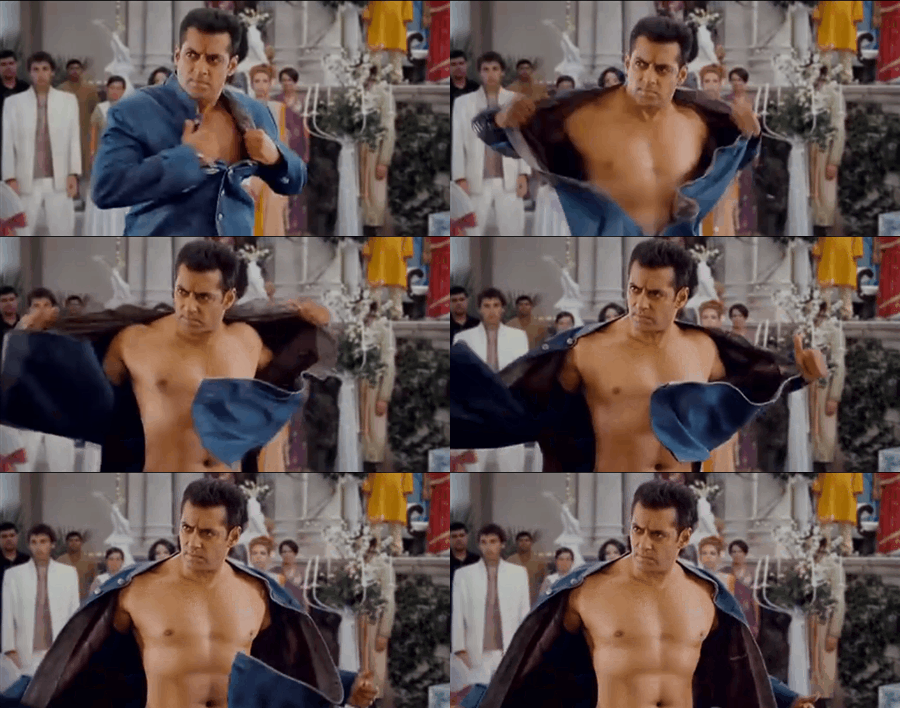
Are you as bored as I am about hearing about Salman Khan? I'm definitely late to the party with this—my hot take—which is more like lukewarm take at this point. And yet, we keep circling back to the question of Salman Khan: is he a good man? Is he a terrible one? Why does everyone love him so much when all he does and says implies a basic lack of respect for other people? Perhaps India's biggest superstar, his fans forgive him everything. Not only do they forgive, they attack like piranhas in a feeding frenzy if you say anything bad about him in their presence. “Bhai” is their guru, their idol, their everything and if you attack him, you're basically attacking their sense of self.


Portrait of a Salman fan


It's easy to write off the Salman supporters as the lowest common denominator, to put a little elite angle on the whole thing, “how could they know any better?” but doing that is dangerous as we see from Trump's success in the US, the people who support him are probably the same sort of people who would—if Indian—be Salman Khan fans. Never dismiss a large group of fans. They're worshipful and their worship is dangerous.

Khan's popularity boils down to this—he is an Indian male role model. How many do we have? Not that many, to be honest. Oh sure, you could want to be a top businessman, or an author or a newscaster, but none of them have the sex appeal, the way of looking into your soul and saying, “I am you” that Khan does. I'm thinking of some of the boys I went to school with, how when end of term report cards came in, some of them spent the entire day in a funk because their fathers would give them a hard time when they went home. Some fathers—I knew this from playmates' houses-- existed only to arrive at the dinner table, when all conversation ceased, when the air grew a bit more tense, when I began to regret accepting the dinner invitation in the first place. These men grunted their acceptance of hot rotis, they looked grimly at their offspring, stroking their mustaches, they nodded politely at my “hello Uncle” but for a moment, they looked a bit pissed off that there was a stranger in their house who they'd have to make conversation with. You spoke in hushed voices around these men, you made a speedy exit, and your friend understood, because they were equally dying to go into their rooms and not make eye contact with this man at all.

The Indian father of the 1990s, in fact, was much like Kevin Arnold's father in The Wonder Years, a show set in the 1960s. Taciturn, sometimes prone to violence, a man who seldom laughed, a man who worked hard for his family, but who didn't show that he loved them in any other way than financial. I was fascinated by these families, even though I had friends with the sort of fathers who remembered your name and asked what you were reading. I was fascinated by the home dynamics, by the fact that these men literally never apologised. Their word was law, and the people it was law for worshipped them for it.

My (very unscientific) theory is that Salman Khan fans come from these sort of homes. Where their fathers laid down the law with a heavy hand. Where the mothers blended into the background. To ask a mortal household god to explain his actions would be as unreasonable as expecting your Ganesha statue to suddenly start talking. Their fathers expressed their distrust of feminism and other “high faluting” words by flared nostrils. I remember watching a video where a son “pranks” his father by telling him he's gay, explaining the joke gleefully to the viewers before telling his dad, who is watching TV with a stone cold face, dressed in a vest and a lungi. Before he can explain it's a joke, this man rises up and starts slapping him with an open palm, hitting his son on every part of his body that he can reach. “No, wait, Papa,” the son keeps saying, and finally manages to get out, “It's a joke! See, there's the camera.” The father lowers his hand, glares at us and his son and walks out.

Trying to figure it out


Maybe I'm wrong, maybe Salman Khan is not their father, but themselves. “It's a joke,” says Salman Khan when he compares himself to a raped woman. “The driver did it,” says Salman Khan, when defending himself against a hit and run charge. You can't slap him, because it's all so terribly funny, the things we get ourselves into while trying to please our fathers. So terribly, terribly funny.